

In recent months, several dairy and oilseed plants in the region have changed hands: sales in insolvency proceedings, court-ordered sales, mergers. In every case the same thing happens. The buildings, the production lines and the land are transferred, but not the information on how all of that is built.
It is not a problem of a careless buyer or a seller hiding something. In most plants, that information was never complete in a single place.
What does not come with the plant
An agro-industrial plant is rarely built all at once. It grows by additions: a new building, a line that is added, a tank that is replaced, an effluent area that is rebuilt. Each stage had its own designer, its own contractor and its own way of documenting. Some ended up on paper, others in files nobody knows how to open, and others simply were never kept.
The result repeats itself: drawings that do not match what was built, extensions from different periods that nobody documented, installations only the maintenance manager who is no longer there knew about. Pipes, channels and pits that only show up when something has to be broken open.
While the plant runs with the same people, that knowledge lives in the people. When the plant changes hands, it leaves with them.
What it costs not to have it
The cost does not appear on any invoice, but it is paid all the same. It is paid when the existing plant has to be surveyed from scratch before any upgrade, paying once again for something that was already paid for when it was built. It is paid when a repair starts by breaking things open to find where something runs. And it is paid in longer shutdowns, because nobody knows for sure what is behind each wall.
The problem has been measured. A NIST study (the US National Institute of Standards and Technology) estimated at US$15.8 billion per year what information that does not flow between those who design, build and operate buildings costs that country. Two thirds of that figure is paid by owners and operators, that is, those who keep the building after construction.
Information is decided during construction
When a plant is built or extended, every change between design and construction is a decision: a pipe that is rerouted, a piece of equipment replaced by another, a pit that is moved. If those decisions are recorded in the model, the plant is handed over with its memory. If they stay in emails, site logs and conversations, they are lost on opening day. And with every change of hands, a little more is lost.
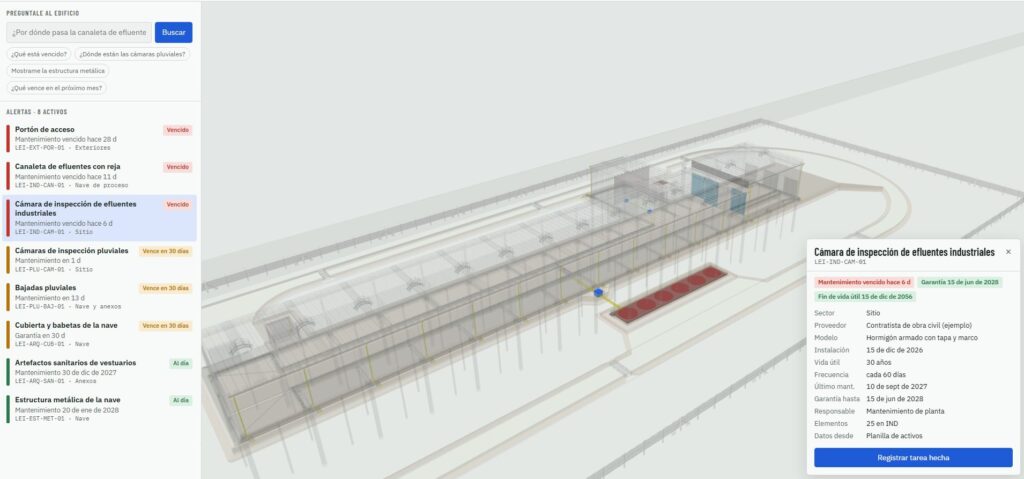
What a plant handed over with its information looks like
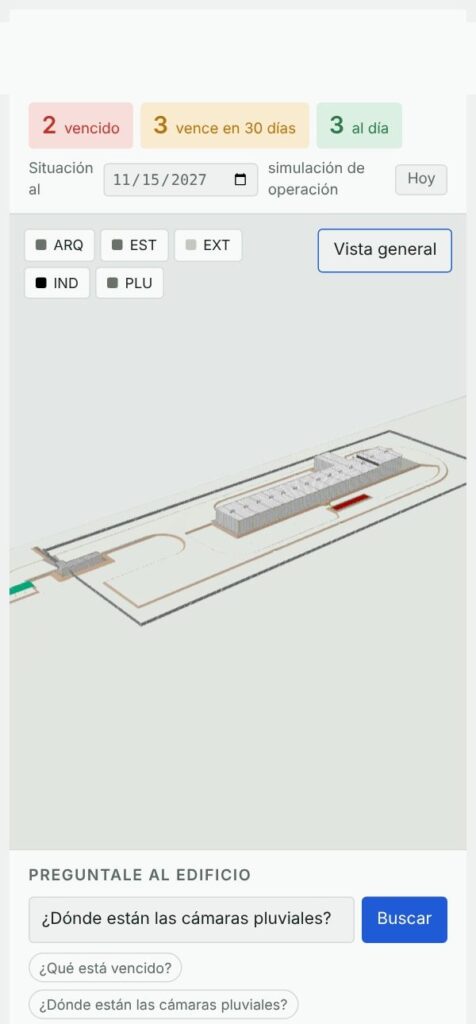
An as-built model is not a mock-up. It is a database that can be queried: where the effluent channel runs, which maintenance is overdue, which warranty expires next month. Whoever operates the plant asks and the building answers. Whoever buys it knows what they are buying.
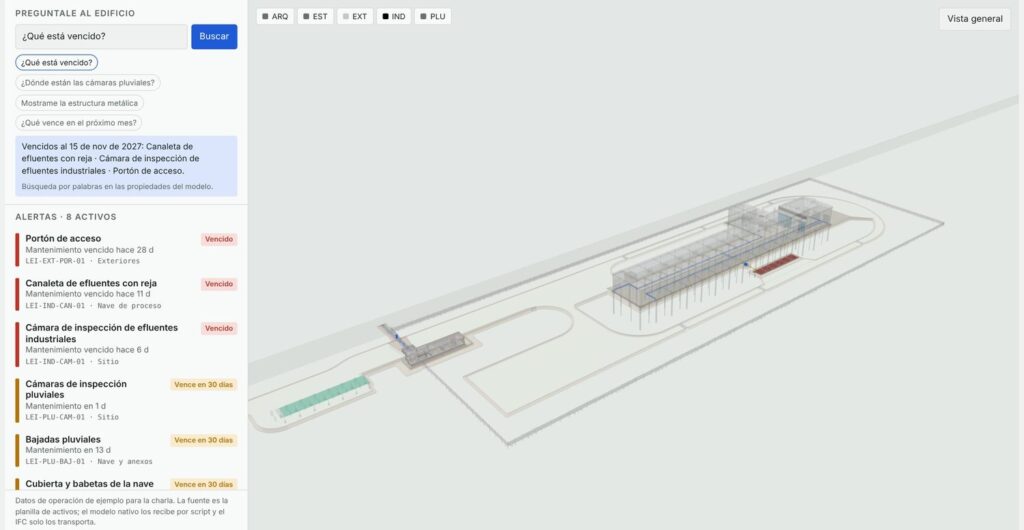
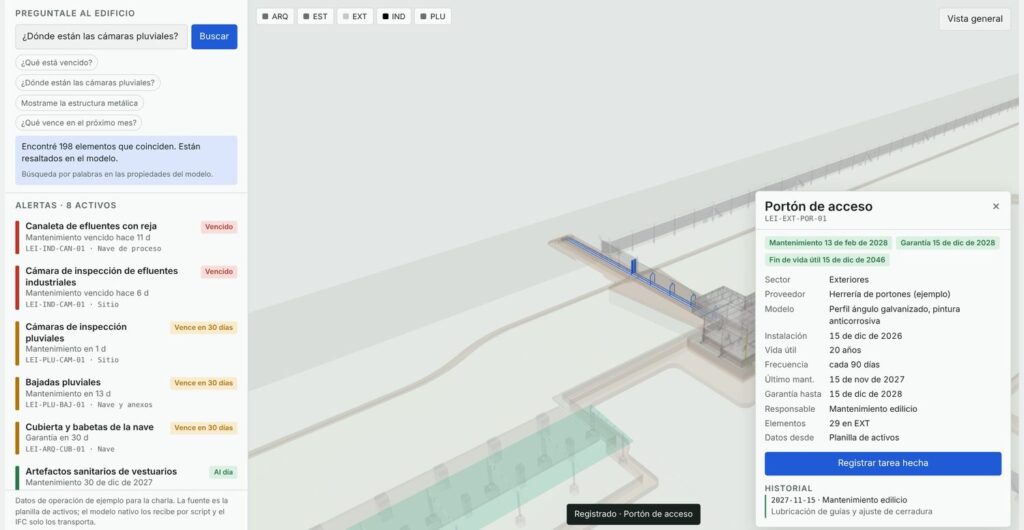
For that to work, every element that matters for operation has to carry concrete data: where it is, what it is, who manufactured it, when it was installed, how long it lasts, how often it is maintained, until when it is under warranty and who is responsible for it. And it has to be in an open format, such as IFC, so that the information does not depend on a specific program or on whoever produced it.
There is no need to invent the method. The ISO 19650 standard has a part devoted precisely to the operational phase of assets, and it provides the framework for defining what information is requested, from whom and when.
If you are buying or have already bought a plant
Before closing, or as soon as you take possession, it is worth requesting and reviewing at least the following:
- As-built drawings for each area, with their date.
- Services drawings: electrical, effluents, stormwater, fire protection and the relevant process installations.
- Equipment list with manufacturer, model and installation date.
- Manuals and current warranties.
- Maintenance records for recent years.
- Current permits and inspections.
If part of that is missing, which is most likely, the first step is not to survey everything. It is a diagnosis: what exists, what is usable, what is missing and what operation really needs. Only then do you decide what to survey and at what level of detail. Surveying everything just in case is expensive; surveying what is needed, not so much.
If you are going to build or extend
Operational information is cheap to obtain at only one moment: during construction. That requires requesting it from the start, in the tender documents or the contract, and defining what information is delivered, with what structure, in what format and who receives it. Asking for it at the end of construction means asking someone to rebuild it from memory.
It helps to ask a single question at the kick-off meeting: what will this model be used for when construction ends?
Where we speak from
At Bertone & Nieva we coordinate projects under construction and produce as-built models and models for operation and maintenance. Information management in agro-industrial plants is also the research line of my master's thesis.
If you operate a plant, or bought one in recent years, we would like to know what documentation you received it with. Write to us, or see how we work in BIM consulting.
Bernardo Bertone · architect and BIM Manager
Think the whole, build the parts